Review Process
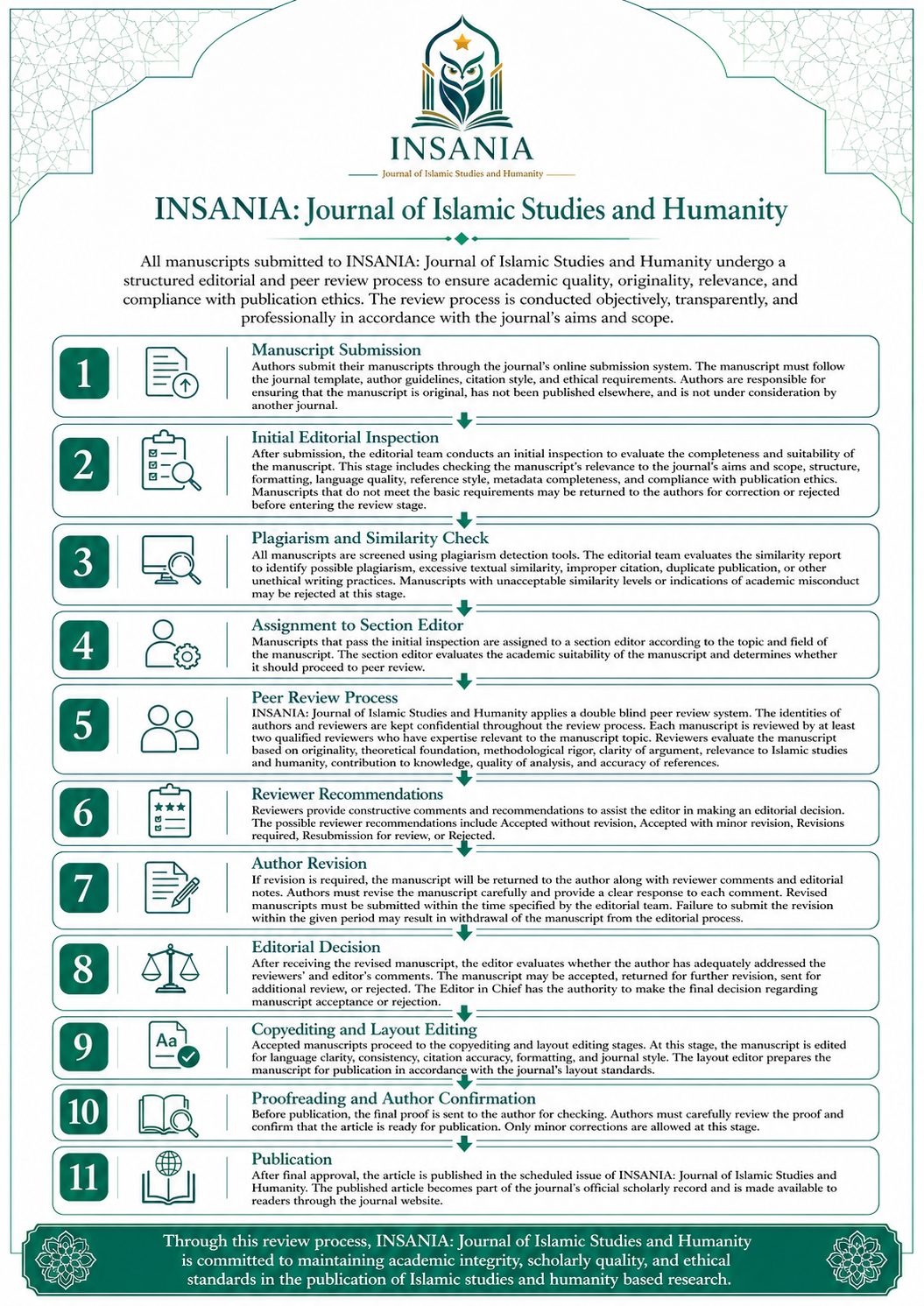
All manuscripts submitted to INSANIA: Journal of Islamic Studies and Humanity undergo a structured editorial and peer review process to ensure academic quality, originality, relevance, and compliance with publication ethics. The review process is conducted objectively, transparently, and professionally in accordance with the journal’s aims and scope.
- Manuscript Submission| Authors submit their manuscripts through the journal’s online submission system. The manuscript must follow the journal template, author guidelines, citation style, and ethical requirements. Authors are responsible for ensuring that the manuscript is original, has not been published elsewhere, and is not under consideration by another journal.
- Initial Editorial Inspection| After submission, the editorial team conducts an initial inspection to evaluate the completeness and suitability of the manuscript. This stage includes checking the manuscript’s relevance to the journal’s aims and scope, structure, formatting, language quality, reference style, metadata completeness, and compliance with publication ethics. Manuscripts that do not meet the basic requirements may be returned to the authors for correction or rejected before entering the review stage.
- Plagiarism and Similarity Check |All manuscripts are screened using plagiarism detection tools. The editorial team evaluates the similarity report to identify possible plagiarism, excessive textual similarity, improper citation, duplicate publication, or other unethical writing practices. Manuscripts with unacceptable similarity levels or indications of academic misconduct may be rejected at this stage.
- Assignment to Section Editor | Manuscripts that pass the initial inspection are assigned to a section editor according to the topic and field of the manuscript. The section editor evaluates the academic suitability of the manuscript and determines whether it should proceed to peer review.
- Peer Review Process | INSANIA: Journal of Islamic Studies and Humanity applies a double blind peer review system. The identities of authors and reviewers are kept confidential throughout the review process. Each manuscript is reviewed by at least two qualified reviewers who have expertise relevant to the manuscript topic. Reviewers evaluate the manuscript based on originality, theoretical foundation, methodological rigor, clarity of argument, relevance to Islamic studies and humanity, contribution to knowledge, quality of analysis, and accuracy of references.
- Reviewer Recommendations | Reviewers provide constructive comments and recommendations to assist the editor in making an editorial decision. The possible reviewer recommendations include Accepted without revision, Accepted with minor revision, Revisions required, Resubmission for review, or Rejected.
- Author Revision | If revision is required, the manuscript will be returned to the author along with reviewer comments and editorial notes. Authors must revise the manuscript carefully and provide a clear response to each comment. Revised manuscripts must be submitted within the time specified by the editorial team. Failure to submit the revision within the given period may result in withdrawal of the manuscript from the editorial process.
- Editorial Decision | After receiving the revised manuscript, the editor evaluates whether the author has adequately addressed the reviewers’ and editor’s comments. The manuscript may be accepted, returned for further revision, sent for additional review, or rejected. The Editor in Chief has the authority to make the final decision regarding manuscript acceptance or rejection.
- Copyediting and Layout Editing | Accepted manuscripts proceed to the copyediting and layout editing stages. At this stage, the manuscript is edited for language clarity, consistency, citation accuracy, formatting, and journal style. The layout editor prepares the manuscript for publication in accordance with the journal’s layout standards.
- Proofreading and Author Confirmation | Before publication, the final proof is sent to the author for checking. Authors must carefully review the proof and confirm that the article is ready for publication. Only minor corrections are allowed at this stage.
- Publication | After final approval, the article is published in the scheduled issue of INSANIA: Journal of Islamic Studies and Humanity. The published article becomes part of the journal’s official scholarly record and is made available to readers through the journal website.
Through this review process, INSANIA: Journal of Islamic Studies and Humanity is committed to maintaining academic integrity, scholarly quality, and ethical standards in the publication of Islamic studies and humanity based research.